Clustered Codebook Quantization for 2D Gaussian-based Image Compression
People
 |
 |
 |
 |
1University College London, 2NVIDIA
ACM SIGGRAPH 2026 Poster Track
(Invited to Technical Paper Talk Panel)
Bibtex
    @inproceedings{cheng2026clustered,
    author    = {Cheng, Runze and Zhan, Yicheng and Spjut, Josef and Ak{\c{s}}it, Kaan},
    title     = {Clustered Codebook Quantization for 2D Gaussian-based Image Compression},
    booktitle = {Special Interest Group on Computer Graphics and Interactive Techniques Conference Posters},
    series    = {SIGGRAPH Posters '26},
    year      = {2026},
    publisher = {Association for Computing Machinery},
    address   = {New York, NY, USA},
    doi       = {10.1145/3799825.3818700},
    }
Resources
Manuscript Supplementary Material Poster Code
Video
Abstract
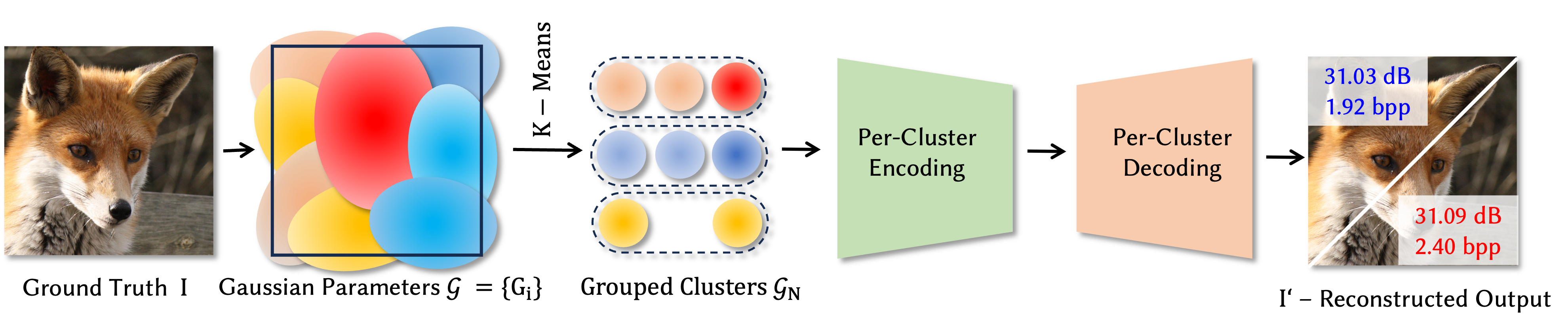
Gaussian-based image representations effectively model image con tent using compact parametric primitives while preserving high visual fidelity, yet storing a large number of floating-point parameters per primitive degrades rate-distortion efficiency at higher fidelity targets. To improve the rate-distortion performance in Gaussian representation, we present our CGVQ, a Gaussian primitive based image compression method. Our key idea is to partition Gaussian parameters further into homogeneous groups prior to quantization, enabling higher compression effi ciency and accurate parameter reconstruction. In practice, our ex tensive experiments show that CGVQ decreases the bpp by 20%↓ with respect to our baseline GaussianImage, while main- taining on-par visual quality.
Motivation
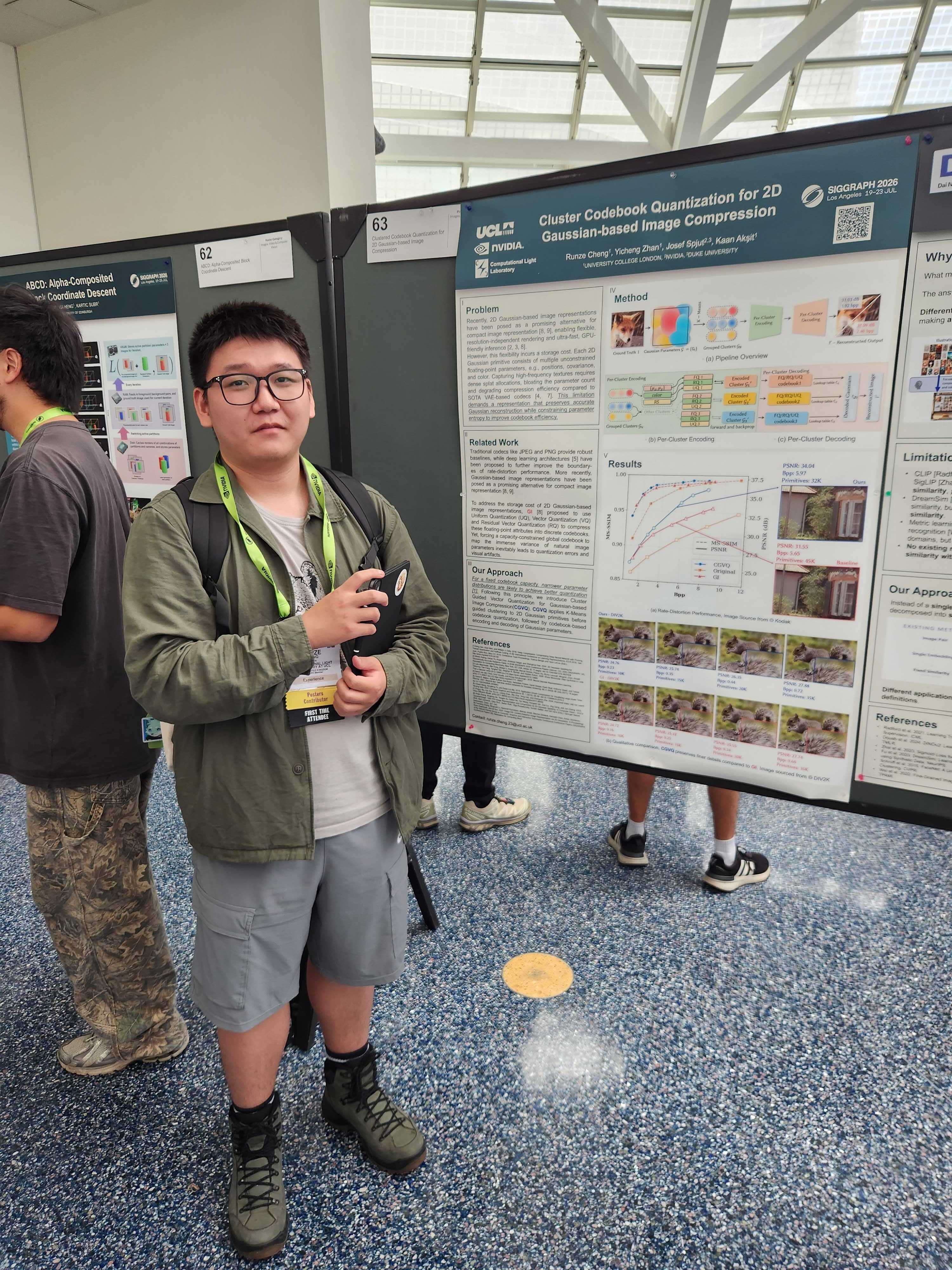
2D Gaussians provide a flexible and GPU-friendly way to represent images, with compact parametric primitives that can render visual content efficiently and independently of resolution. Yet accurate reconstruction still requires many Gaussian primitives, and each primitive carries several floating-point attributes, including position, rotation-scale, and color. As image details become richer, these parameters quickly increase the storage cost. Prior GaussianImage-style compression reduces this cost with vector quantization, but a single global codebook must model the wide variance of natural image parameters, often causing quantization errors and visible artifacts. Our insight is simple: for a fixed codebook capacity, narrower parameter distributions are easier to quantize. By clustering Gaussian primitives before codebook training, CGVQ enables localized codebooks that better preserve reconstruction quality at lower bitrate.
Method
Encoding
Given an input image, we first fit it with a set of 2D Gaussian primitives, where each primitive stores position, rotation-scale, and color attributes. CGVQ then applies K-Means to partition these primitives into homogeneous clusters based on a concatenated rotation-scale and color feature vector, grouping Gaussians with similar appearance and anisotropy before quantization
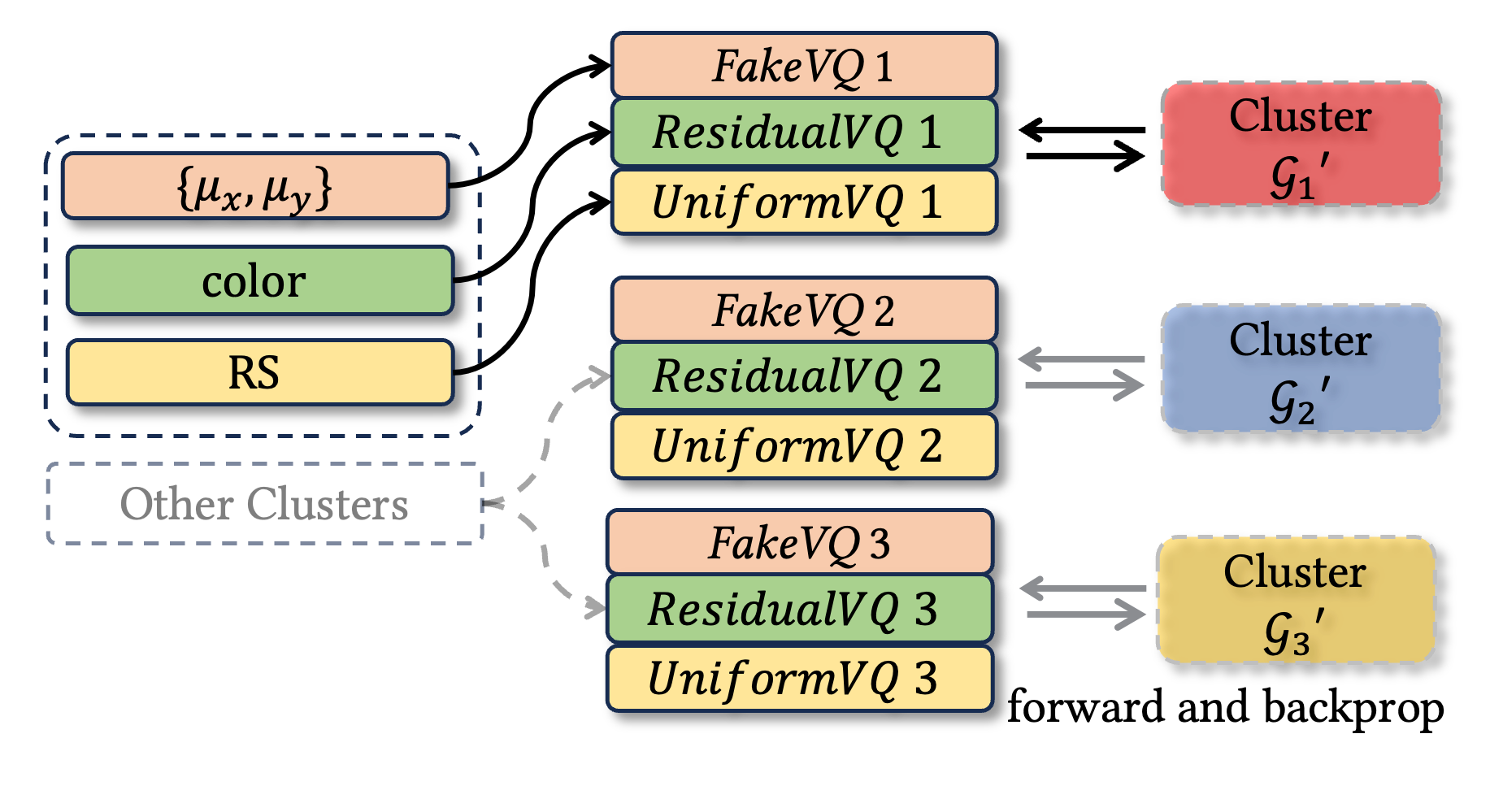
In the encoding step, each cluster is compressed independently with dedicated codebooks for different Gaussian attributes. Specifically, position is encoded with a 16-bit floating-point quantization-aware estimator, rotation-scale is compressed using uniform vector quantization, and color is encoded with residual vector quantization for finer residual refinement. These parameter-specific codebooks are trained per cluster, allowing CGVQ to exploit the lower variance of each grouped distribution.
Decoding
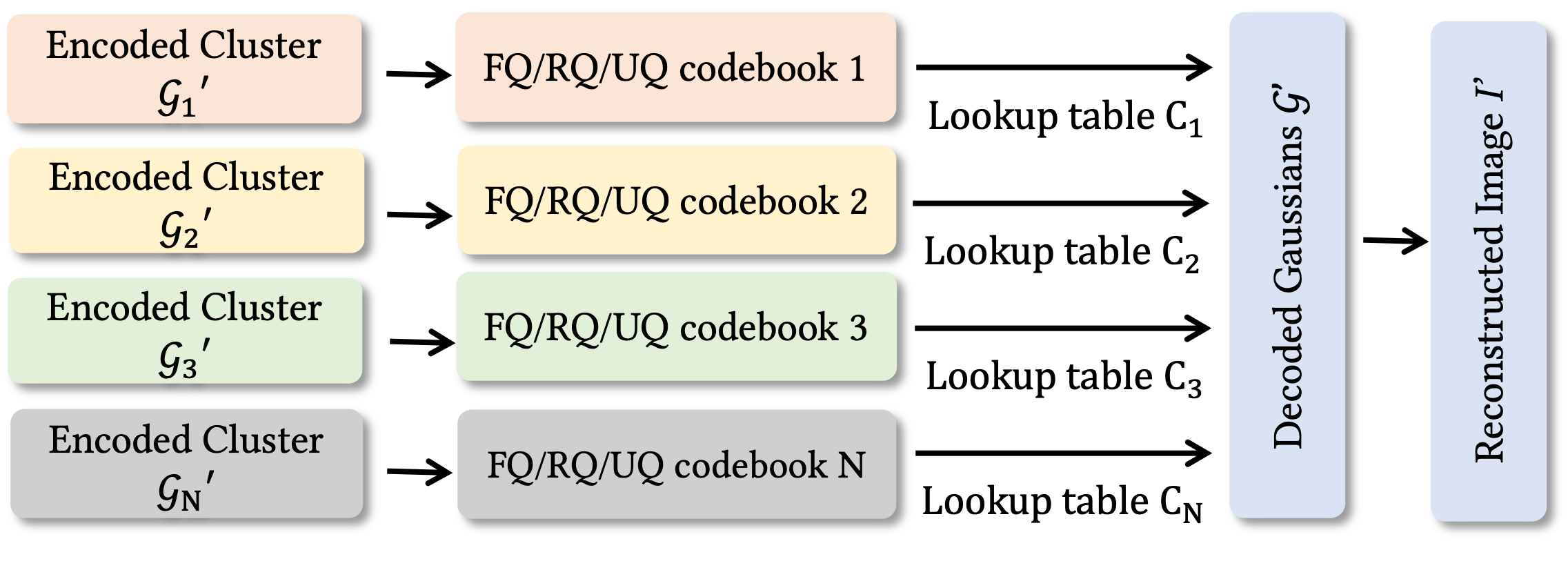
During decoding, each cluster is reconstructed through codebook lookup, and all decoded Gaussian primitives are composed together to render the final reconstructed image.
Result
On the Kodak dataset, CGVQ achieves a better rate-distortion trade-off than the GaussianImage baseline. Across the evaluated bitrate range, our clustered codebook design improves both PSNR and MS-SSIM at comparable Bpp, with the advantage becoming more evident in the high-quality regime above 30 dB.
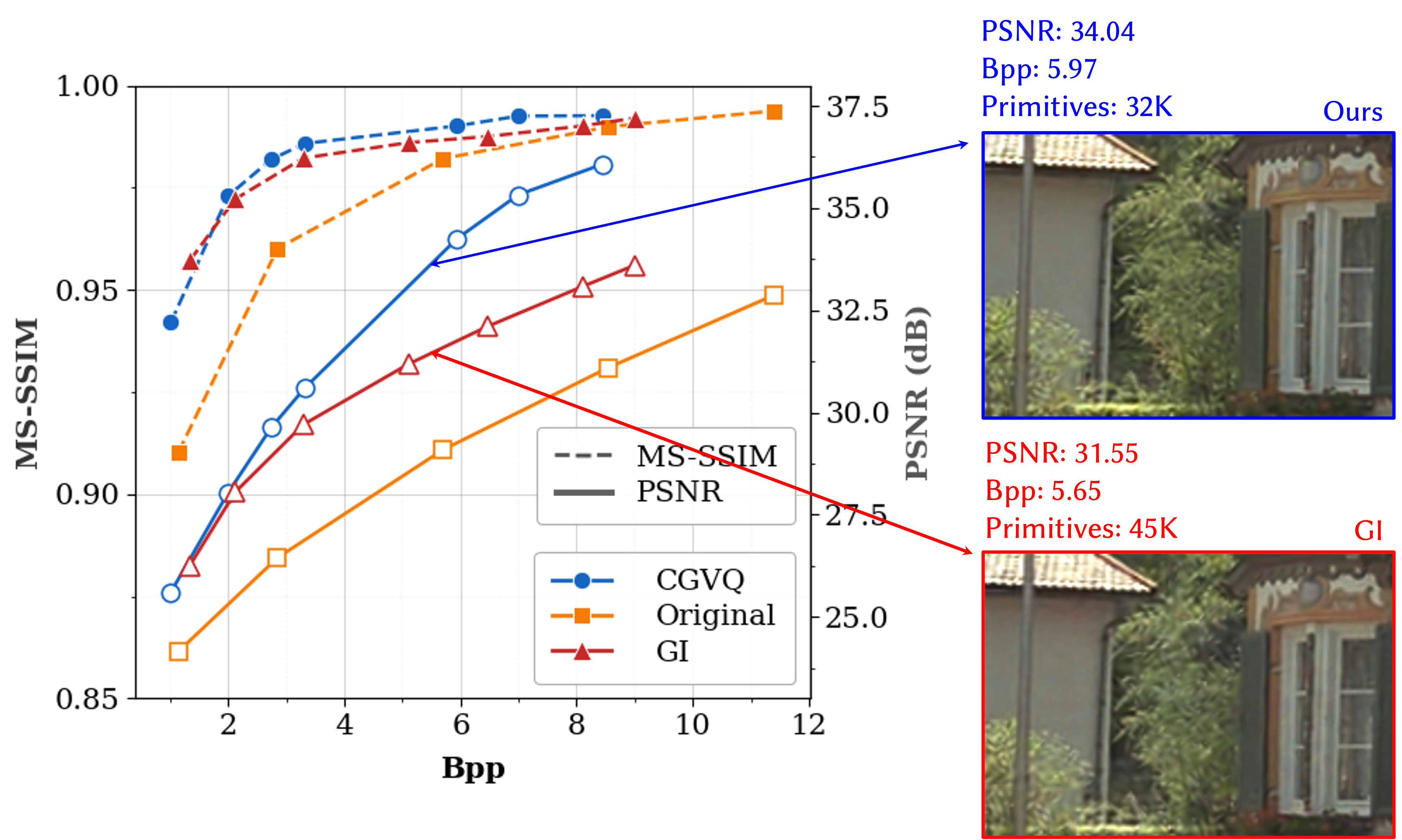
Qualitatively, CGVQ also preserves finer image details under the same primitive budget. With 15K Gaussian primitives, CGVQ improves PSNR by 1.68 dB over GI, and reaches visual quality comparable to GI using 19K primitives. This shows that clustering Gaussian parameters before quantization can reduce redundancy while maintaining accurate reconstruction.

Performance Trade-off
Increasing the number of clusters improves reconstruction quality by narrowing the parameter distribution for each codebook. This gain comes with higher bitrate and slower encoding/decoding, showing a trade-off between compression fidelity and computational efficiency.
| Primitives-Clusters | PSNR ↑ | MS-SSIM ↑ | Bpp ↓ | Encoding (s) ↓ | Decoding (s) ↓ | Decoding FPS ↑ |
|---|---|---|---|---|---|---|
| 10000-1 | 26.02 | 0.9529 | 1.32 | 32.57 | 0.00418 | 239.2 |
| 10000-4 | 28.01 | 0.9732 | 1.75 | 149.83 | 0.00940 | 106.4 |
| 10000-8 | 28.13 | 0.9738 | 2.00 | 255.11 | 0.01460 | 68.5 |
| 10000-16 | 28.16 | 0.9738 | 2.51 | 488.18 | 0.02530 | 39.5 |
| 20000-1 | 29.33 | 0.9796 | 2.64 | 34.32 | 0.00750 | 133.3 |
| 20000-4 | 30.71 | 0.9864 | 3.19 | 168.86 | 0.01340 | 74.6 |
| 20000-8 | 30.90 | 0.9866 | 3.45 | 285.18 | 0.01870 | 53.5 |
| 20000-16 | 31.18 | 0.9869 | 4.01 | 531.33 | 0.03000 | 33.3 |
Photo gallery
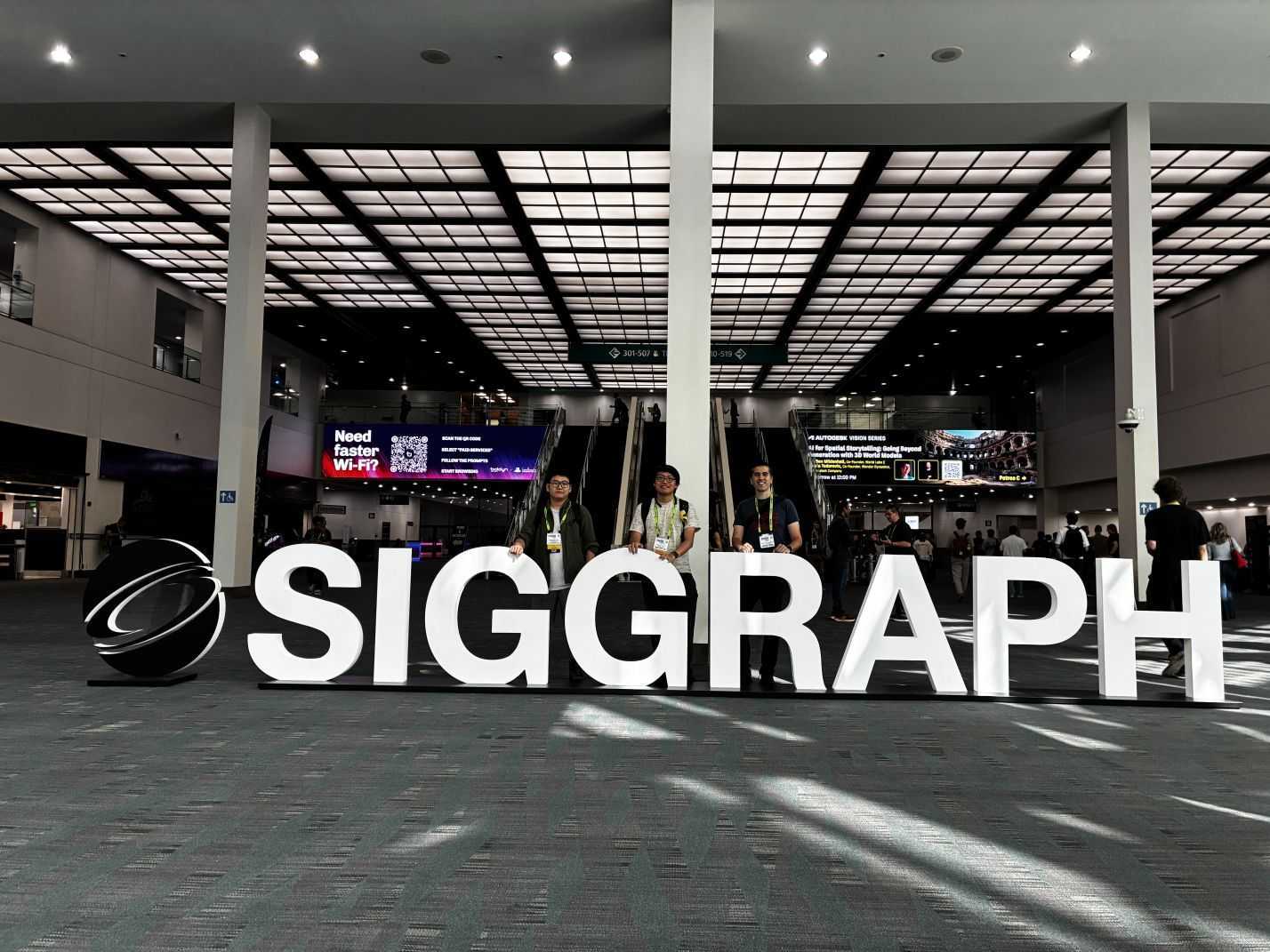
Here we record some of our activities from SIGGRAPH 2026 in Los Angeles, 19-23 July.
Acknowledgements
This work builds upon GaussianImage, which serves as the backbone implementation and baseline for our method. We thank the authors for making their code publicly available.
Relevant research works
- Complex-Valued 2D Gaussian Representation for Computer-Generated Holography
- Complex-Valued Holographic Radiance Fields
- Compressing Double Phase Holograms using 2D Gaussians
- Assessing Learned Models for Phase-only Hologram Compression
- Multi-color Holograms improve Brightness in Holographic Displays
- Realistic Defocus for Multiplane Computer-Generated Holography
- Odak
Outreach
We host a Slack group with more than 250 members on rendering, perception, displays and cameras. The group is open to the public — join via this link.
Contact Us
Warning
Please reach us through email to provide your feedback and comments.